
There is no frigate like a book
To take us lands away
Emily Dickinson
Showing posts with label Hirahara Naomi. Show all posts

Friday, March 16, 2012


Snakeskin ShamisenSnakeskin Shamisen by Naomi Hirahara
My rating: 4 of 5 stars

Japanese Americans are a very unique group. As far as I know they are the only  people who have names for the different generations with in their group. The SOB (Straight off the boat) are  the Issei, their children the second generation are the Nisei and their grandchildren or third generation are the Sansei.  In addition to this they are one of the most resilient people who suffered great indignities and hardships  in the course of their history in the Western Hemisphere. It was not until the 1950's that they were allowed to become naturalized American Citizens. Despite being interned during the war, losing their property and more they elected to look to the future rather than to the past.

There is a subgroup the Kibei Nisei who were born in America and raised in Japan. Mas Arai is one of these young men who eventually found himself deep in a subterranean train station in Hiroshima during the 1945 bombing and it had naturally marked his life in very significant ways. He is now a 70 year old part time gardener who is getting a reputation for solving murders and he gets involved in the death of a recent lottery winner. The situation is complex and reaches back to Okinowa and WWII, to the red scare in the 50's and brings up some of the bad things men do for what they think are good reasons.

Mas Arai may appear to be a grumpy old man, but in reality he is just a person who suffers fools badly, has little use for regrets about things that cannot be changed and he never wears his heart on his sleeve but he definitely has one.

There are a lot of characters to keep straight and convoluted motives but you won't regret reading this book, both for the history and the mystery. The tidbit I took home was the fact that many Japanese went to Peru when a call when out in a need for labourers. The Peruvian government rounded up these Japanese-Peruvians and sold them to the US Government who planned to exchange them for US POWs who were being held by Japan. This tranfers was incomplete but some were sent to Japan.. The other kidnapees were held in Texas and eventually release and some stayed in the US and some returned to Peru and their previous lives. Peru refused to have most back and they languished in Crystal City,Texas for two years after the war was over.
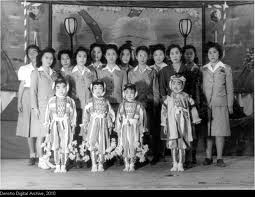
Crystal City Internees

Crystal CityInternees 


Wednesday, March 14, 2012


Gasa-Gasa GirlGasa-Gasa Girl by Naomi Hirahara
My rating: 4 of 5 stars


Mari Arai was always known to her parents as being gaza-gasa, an into everything kind of girl,  just the opposite of laid back. Mas Arai, her dad tells her she takes after her mother. Mari  retorts that her mother claimed it was a trait taken from her father. This may be the closer to the truth. Mas Arai had dreams of becoming an engineer but he life took another path after he was fortunate enough to survive the Hiroshima bomb.


Mas ended up becoming a gardener in the LA area and spent many decades at this craft. Retirement is a word that he knows will never apply to him. He spent many years living very quietly until he was involved in a case chronicled in THE SUMMER OF THE BIG BACHI the first in this series by Naomi Hirahara. Now he is traveling to New York because his daughter has issued a cry for help.


He is just getting his feet accustomed to concrete sidewalks when he discovers the dead body of his son-in law LLoyd's boss in a Koi pond with mysterious markings. This victim was Kazzy Ouchi a magnate in the silk garment industry was the son of a humble gardener at a big New York City estate. Mas becomes enmeshed in the complex affair because one of his strengths is that he is not a quitter. Mari and Lloyd are in the middle of this scenario and Mas investigates so he can extricate them.


This is a lovely book with interesting fascinating characters who have a background as a part of American history. The author touches gently on all the different generations of Japanese-Americans and how East coast and West coast lives of the citizens differ.